Some scary stats about agriculture and biodiversity

20 07 2018

84438Last week we had the pleasure of welcoming the eminent sustainability scientist, Professor Andrew Balmford of the University of Cambridge, to our humble Ecology and Evolution Seminar Series here at Flinders University. While we couldn’t record the seminar he gave because of some of the unpublished and non-proprietary nature of some of his slides, I thought it would be interesting, useful, and thought-provoking to summarise some of the information he gave.

Andrew started off by telling us some of the environmental implications of farming worldwide. Today, existing agriculture covers more than half of ‘useable’ land (i.e., excluding unproductive deserts, etc.), and it has doubled nitrogen fixation rates from a pre-industrial baseline. Globally, agriculture is responsible for between 19 and 35% of all greenhouse gas emissions, and it has caused approximately 40% increase in observed sea-level rise (1961-2003). Not surprisingly, agriculture already occupies the regions of highest biodiversity globally, and is subsequently the greatest source of threat to species.

Read the rest of this entry »


Biodiversity is everyone’s responsibility

13 07 2018

Workspace: Team Of Diverse Workers Put Hands TogetherI’m not sure if many South Australians are aware of this, but the Parliamentary Inquiry into Biodiversity by the Environment, Resources and Development Committee presented a report to the 53rd Parliament of South Australia in March 2017. I thought it worthwhile reproducing their executive summary here on CB.com (I’ve highlighted the text that I deem to be rather insightful and simultaneously damning from our own elected government representatives):

This report summarises the findings and recommendations of the South Australian Parliament’s Environment, Resources and Development Committee’s inquiry into biodiversity in South Australia. Specifically, the inquiry investigated the regulatory and policy framework to determine whether it appropriately supports terrestrial and marine ecological processes, biodiversity values and abates species extinction.

The Committee found that in spite of the efforts of the State and Federal governments, industry and private landholders in South Australia, the condition of biodiversity in the State continues to decline. Species extinctions have occurred in the past and a further “extinction debt” still exists. There is no reason to believe that this trend will improve without a change to the way we approach biodiversity conservation.

A key theme to emerge from the Inquiry is that biodiversity conservation needs to be everyone’s responsibility; State and Federal government, industry, the broader community, and private landholders.

This also means that biodiversity conservation needs to occur across both public and private land, with actions coordinated at a landscape scale.

Making biodiversity conservation everyone’s responsibility requires a range of measures, including legislative reform, improved management of threats and greater involvement of the community. The provision of greater resources would yield faster results.

This report has focused on several key themes that emerged from submissions to the Inquiry.

Regulating for better biodiversity – South Australia’s legislative framework

South Australia’s current legislative framework does not provide for optimum biodiversity outcomes.

Three key issues contribute to this –

  • an out-of-date suite of environmental legislation that lacks cohesion and consistency, particularly regarding enforcement and compliance provisions;
  • inadequate and incomplete processes for identifying and protecting at-risk elements that need special measures (e.g. for protection of specific threatened species and ecological communities); and
  • inadequate consideration of biodiversity conservation in legislation that regulates human activities. In particular, there is a lack of cohesion between the environmental legislative and policy framework and land use planning, assessment and approval.
  • Statutory fragmentation of biodiversity considerations – that is, consideration of different aspects of biodiversity under different pieces of legislation – results in lack of cohesion and consistency, duplication and inefficiency, and makes it difficult to implement a landscape approach or to identify strategic opportunities and risks.

Taken as a whole, current enforcement provisions do not provide for effective and proportionate compliance action. Enforcement and compliance provisions across the relevant legislation are uneven in their approach. For example, penalties appear to be disproportionate and not risk-based (although there are some exceptions). Modern enforcement tools such as compliance orders, civil remedies and alternative penalties (such as administrative penalties, payment of damages including exemplary damages, remediation orders etc) are not included in all relevant legislation. There is some duplication in offences and inconsistency in the types of sanctions and penalty ranges.

There is an urgent need to amend the legislative framework to support any attempt to improve biodiversity outcomes.

The best approach will be based on clear, shared responsibility for biodiversity outcomes, supported by individual accountability. However, such a change will require policy development and drive.

To ensure forward momentum and improvements in the short term while developing the policy settings to support such a step-change, a staged approach could be implemented. There are various ways this could be achieved.

The Committee suggests a 3-stage approach to reforming the legislative framework. The Committee recommends the creation of a Biodiversity Expert Panel that is responsible for advancing this 3-stage approach.

  1. The first stage will involve amendments to improve operation and effectiveness of the regulatory regime within current policy settings, acknowledging that as a result of Stage 3, provisions may be altered or moved into different pieces of legislation. Amendments generally would be to the existing ‘environmental’ Acts, and primarily to the National Parks and Wildlife Act 1972 and Native Vegetation Act 1991. They would include many of the specific areas for amendment identified in EDO submissions (2011 & 2015) as well as in the SA Government submission, for example, beginning with amendments to improve current environmental legislation.
  2. Stage 2 would progress to amendments to improve integration between Acts and improve support for landholders and community participation.
  3. Stage 3 would implement a system whereby all resource use and management would be managed by one piece of legislation, with protection of biodiversity and sustainable development at its core. Provisions for protected area management, and for the scientific work involved in identifying threatened species and communities, may be contained in separate legislation.

Threats, ecological resilience and restoration

The State’s native biodiversity is facing myriad of current threats, including habitat loss and fragmentation (due to development and changing land-use), pest plants and animals, and control burn regimes. There is a need for more stringent vegetation protection, better informed and enacted control and management strategies of known pest plants and animals, and a revision of burning regimes.

Future threats to the State’s biodiversity will be largely driven by climate change impacts and the interaction with existing major threats (e.g. urbanisation and changing land use). Adequately preparing for and managing such future threats will require knowledge of projected changes and pro-active preparation for such changes.

Working with the community

Involvement of the community is an essential part of any biodiversity conservation strategy for the State. It is a foundation stone for moving to a point where biodiversity conservation is everyone’s business.

Community engagement will become increasingly important for biodiversity conservation, especially given the growing role of volunteers to support works on public land as well as the voluntary conservation efforts of private landholders. The expanding role of volunteers reenforces that biodiversity conservation is everyone’s business.

South Australia’s approach to biodiversity conversation on private land needs to be reinvigorated.

Cross cutting themes

There were several cross cutting themes identified in submissions to the Inquiry. There was broad recognition of the strong cultural and historic significance of elements of biodiversity to Aboriginal people, and that this is often poorly understood outside those communities. Continuing to identify ways for Aboriginal people to contribute to land and water management in South Australia remains a priority.

With respect to knowledge generation, critical knowledge gaps exist that need to be filled and existing knowledge is not being adequately understood, communicated or applied. From a resourcing perspective, there is concern that insufficient funds are being allocated to biodiversity conservation, which is affecting work on public and private lands.

The management of over-abundant species in South Australia remains a challenge, noting the recent impacts of long-nose fur seals in the Lower Lakes and Coorong, and ongoing concerns regarding the impact of animals such as little corellas and some species of kangaroos on negative vegetation.


How to feed the world without costing the Earth

5 07 2018

image_normalI’m excited to announce the upcoming public lecture by world-renowned sustainability scientist, Professor Andrew Balmford, at Flinders University on 17 July 2018.

Andrew is Professor of Conservation Science and a Royal Society Wolfson Research Merit Award holder at the Department of Zoology, University of Cambridge, and is on sabbatical at University of Tasmania until December 2018. His main research interests are exploring how conservation might best be reconciled with land-demanding activities such as farming, quantifying the costs and benefits of effective conservation, and examining what works in conservation. In his book Wild Hope (Chicago University Press), he argues that cautious optimism is essential in tackling environmental challenges. Andrew helped establish the Student Conference on Conservation Science, and Earth Optimism.

EcolEvolFlindersLogoProfessor Balmford will be presenting his seminar “How to feed the world without costing the Earth” (hosted by the Ecology & Evolution Research Group) at the Bedford Park Campus of Flinders University in South Lecture Theatre 1, from 12:00-13:00 on 17 July 2018. All are welcome.

Abstract: Globally, agriculture is the greatest threat to biodiversity and a major contributor to anthropogenic greenhouse gas emissions. How we choose to deal with rising human food demand will to a large degree determine the state of biodiversity and the wider environment in the 21st century. Read the rest of this entry »


Cartoon guide to biodiversity loss XLIX

2 07 2018

The fourth set of six biodiversity cartoons for 2018. See full stock of previous ‘Cartoon guide to biodiversity loss’ compendia here.


Read the rest of this entry »


Personal deterrents can reduce the risk of shark bites

19 06 2018
Shak deterrent testing

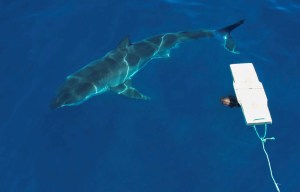
Photo: Charlie Huveneers

A little over a week ago, shark ecologist, Charlie Huveneers, and I attempted to write an article in The Conversation about a report we co-wrote regarding the effectiveness of personal shark-deterrent devices (see below for more on the report itself). It’s a great little story, with both immediate policy implications for human safety and great, big potential improvements to shark conservation in general (i.e., if sharks kill fewer people, then perhaps governments would be less inclined to invokes stupid laws to kill sharks). Indeed, sharks aren’t doing very well around the world, mainly because of over-harvest and persecution from unfounded fear.

Anyway, all was going swimmingly until our editor at The Conversation suddenly decided that they wouldn’t publish the piece based on the following funding disclaimer that we had submitted with the article:

This project was funded by the New South Wales Department of Primary Industries Shark Management Strategy Competitive Annual Grants Program, the Government of South Australia, Ocean Guardian Pty Ltd, and the Neiser Foundation. We openly and transparently declare that Ocean Guardian contributed financially to the study, but that Ocean Guardian was not involved in the study design or implementation, nor did they have access to the data post-collection. Nor did Ocean Guardian provide input into data analysis, interpretation, writing of the report, or the conclusions drawn. The study design followed a protocol developed for a previous study, which was not funded by Ocean Guardian. In summary, Ocean Guardian had no opportunity to influence any aspect of the study or its conclusions, apart from providing some financial support to realise the field project (e.g., boat hire, equipment purchase, etc.) in the same manner as the other funding agencies. The South Australian cage-diving industry provided logistical support during the testing of the deterrents.

The long and short of The Conversation‘s negative decision was that one of the companies contributed financially to project. However, as we stated above, they had absolutely no influence in the subsequent experimental design, data collection, analysis, interpretation or report writing.

While normally I’m a big fan of The Conversation, I really think they dropped the ball with this one. Their decision was illogical and unsupported for five main reasons:

  1. There were many funding partners involved, and the Ocean Freedom contribution was in no way the major or even majority share of funding.
  2. Other companies with devices tested could have contributed, but only Ocean Freedom offered.
  3. The study was commissioned by a state government agency (New South Wales Department of Primary Industries), which is not a commercial entity.
  4. As stated in our disclosure, there was no opportunity for manipulating experimental design, data ownership, or post-collection analysis or writing that could have influenced the results, by any funders or contributors.
  5. The disclosure is open, honest, comprehensive and in every way truthful.

So, I’m more than just a little disappointed — and my opinion of the organisation has dropped considerably. That, with the constant barrage of donation requests they send makes me think twice about their journalistic integrity. I challenge others to think carefully before giving them any money.

Regardless, let’s move on to the article itself (which I can publish freely here without the Draconian oversight of The Conversation):

Many things might explain why the number of shark bites appear to be increasing. However, the infrequent occurrence of such events makes it nearly impossible to determine why. Recently, an atypically high rate of shark bites occurred in Western Australia in 2010-2011 and on the north coast of New South Wales in 2015-2016. These highly publicised events — often sensationalised in both traditional and social media — have pressured governments to implement new measures to reduce the risk of shark bites.

The rising pressure to do something to reduce shark bites has prompted the recent development or commercial release of many new personal shark deterrents. Yet, most of these devices lack any rigorous scientific assessment of their effectiveness, meaning that some manufacturers have made unfounded claims about how much their devices dissuade sharks from attacking humans.

However, if a particular type of commercially available shark deterrent happens to be less effective (or completely ineffective) as advertised, it can give users a false sense of security, potentially encouraging some to put themselves at greater risk than is necessary. For example, some surfers and spearfishers probably ignore other mitigation measures, such as beach closures, because they ‘feel safe’ when wearing these products.

Read the rest of this entry »


Communicating climate change

5 06 2018

Both the uncertainty inherent in scientific data, and the honesty of those scientists who report such data to any given audience, can sow doubt about the science of climate change. The perception of this duality is engrained in how the human mind works. We illustrate this through a personal experience connecting with global environmentalism, and synthesise some guidelines to communicate the science of climate disruption by humans.

EskimoTote_English

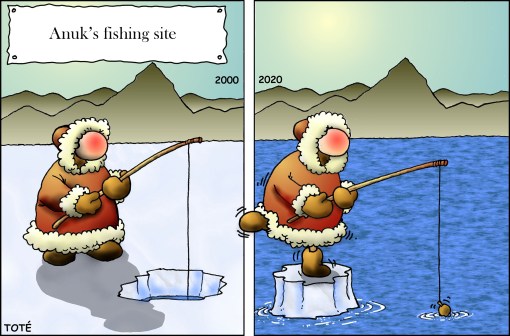
Courtesy of Toté (www.elcomic.es)

In January 2017, the Spanish environmental magazine Quercus invited us to give a talk, at the Cabinet of Natural History in Madrid, about our article on the effects of climate change on the feeding ecology of polar bears, which made to Quercuscover in February 2017 (1) — see blog post here. During questions and debate with the audience (comprising both scientists and non-scientists), we displayed a graph illustrating combinations of seven sources of energy (coal, water, gas, nuclear, biomass, sun and wind) necessary to meet human society’s global energy needs according to Barry Brook & Corey Bradshaw (2). That paper supports the idea that nuclear energy, and to a lesser extent wind energy, offer the best cost-benefit ratios for the conservation of biodiversity after accounting for factors intimately related to energy production, such as land use, waste and climate change.

While discussing this scientific result, one member of the audience made the blunt statement that it was normal that a couple of Australian researchers supported nuclear energy since Australia hosts the largest uranium reservoirs worldwide (~1/3 of the total). The collective membership of Quercus and the Cabinet of Natural History is not suspicious of lack of awareness of environmental problems, but a different matter is that individuals can of course evaluate a piece of information through his/her own and legitimate perspective.

The stigma of hypocrisy

Indeed, when we humans receive and assimilate a piece of information, our (often not self-conscious) approach can range from focusing on the data being presented to questioning potential hidden agendas by the informer. However, the latter can lead to a psychological trap that has been assessed recently (3) — see simple-language summary of that assessment in The New York Times. In one of five experiments, a total of 451 respondents were asked to rank their opinion about four consecutive vignettes tracking the conversation between two hypothetical individuals (Becky & Amanda) who had a common friend. During this conversation, Amanda states that their friend is pirating music from the Internet, and Becky (who also illegally downloads music) can hypothetically give three alternative answers: Read the rest of this entry »


Greater death rates for invasive rabbits from interacting diseases

30 05 2018

When it comes to death rates for invasive European rabbits (Oryctolagus cuniculus) in Australia, it appears that 1 + 1 = 2.1.

Pt tagged rab with RHD+myxo 1 10-08

Tagged European rabbit kitten infected with myxoma virus, but that died from rabbit haemorrhagic virus disease (RHDV). Photo by David Peacock, Biosecurity South Australia.

“Canberra, we have a problem” — Sure, it’s an old problem and much less of one than it used to be back in the 1950s, but invasive rabbits are nonetheless an ecological, conservation, and financial catastrophe across Australia.

relative rabbit abundance South Australia

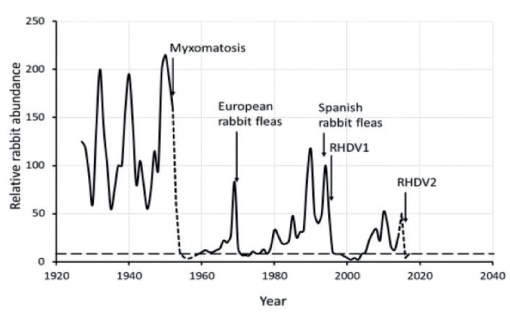
Semi-schematic diagram, redrawn using data from Saunders and others and extended to include the recent spread of RHDV2, showing changes in rabbit abundance in relation to the introduction of biological control agents into north-eastern South Australia. Dotted lines indicate uncertainty due to lack of continuous annual data. The broken line indicates a level of about 0.5 rabbits ha-1, below which rabbits must be held to ensure recovery of native pastures and shrubs (from B. Cooke 2018 Vet Rec doi:10.1136/vr.k2105)

Rabbits used to reach plague numbers in much of agricultural and outback Australia, but the introduction and clever manipulation of two rather effective rabbit-specific viruses and insect vectors — first, myxoma virus in 1950, European rabbit fleas in the 1960s to help spread the virus, then Spanish rabbit fleas in the 1990s to increase spread into arid areas, and then rabbit haemorrhagic disease virus (RHDV) in 1995 — have been effective in dropping rabbit abundances by an estimated 75-80% in South Australia alone since the 1950s.

Read the rest of this entry »


What Works in Conservation 2018

23 05 2018
P1230308

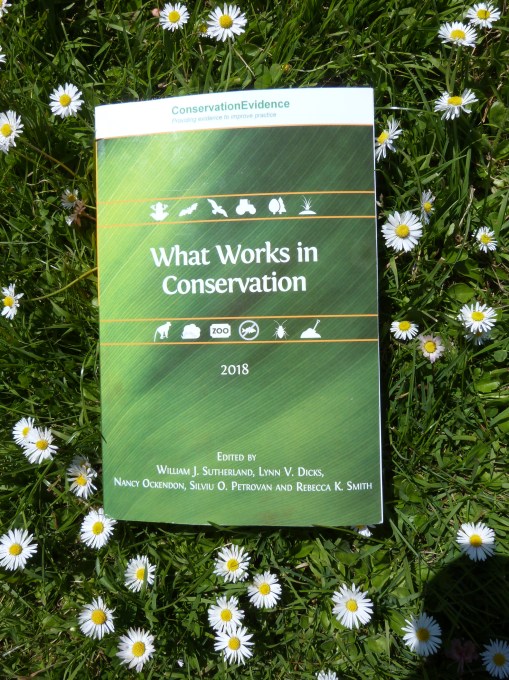
Do you have a copy of this book? If not, why not?


This book is free to download. This book contains the evidence for the effectiveness of over 1200 things you might do for conservation. If you don’t have a copy, go and download yourself a free one here, right now, before you even finish reading this article. Seriously. Go. You’ll laugh, you’ll cry, it’ll change your life.

Why you’ll laugh

OK, I may have exaggerated the laughing part. ‘What Works in Conservation 2018’ is a serious and weighty tome, 660 pages of the evidence for 1277 conservation interventions (anything you might do to conserve a species or habitat), assessed by experts and graded into colour-coded categories of effectiveness. This is pretty nerdy stuff, and probably not something you’ll lay down with on the beach or dip into as you enjoy a large glass of scotch (although I don’t know your life, maybe it is).

But that’s not really what it’s meant for. This is intended as a reference book for conservation managers and policymakers, a way to scan through your possible solutions and get a feel for those that are most likely to be effective. Once you have a few ideas in mind, you can follow the links to see the full evidence base for each study at conservationevidence.com, where over 5000 studies have been summarised into digestible paragraphs.

The book takes the form of discrete chapters on taxa, habitats or topics (such as ‘control of freshwater invasives’). Each chapter is split into IUCN threat categories such as ‘Agriculture’ or ‘Energy production and mining’. For each threat there are a series of interventions that could be used to tackle it, and for each of these interventions the evidence has been collated. Experts have then graded the body of the evidence over three rounds of Delphi scoring, looking at the effectiveness, certainty in the evidence (i.e., the quality and quantity of evidence available), and any harms to the target taxa. These scores combine to place each intervention in a category from ‘Beneficial’ to ‘Likely to be ineffective or harmful’. Read the rest of this entry »


Science + music = productivity

17 05 2018

da2a4c4015f37dcd15015a2bfcef2a2dA take on a small section of my recent book, The Effective Scientist, about the importance of music in science.
I don’t know any scientists who don’t love music, and I will go out on a limb by stating that most of us probably combine our science activities with music during the quieter times in front of the computer.

One tool that can effectively mask distractions when writing or coding, especially noisy ones, is music. I consider my earphones to be an essential tool of the science trade, for they allow me to ‘tune out’ as I ‘tune in’ to my favourite mood music.

However, a little caution is required here. If the music is set to loud to mask the ambient noises that you are presently finding annoying, you might discover that your capacity to concentrate is reduced. The style of music is also important. When I am writing actual text, anything that could induce the slightest foot tapping or head banging tends to send me off into space; I prefer something light and instrumental in these circumstances, like Vivaldi, Mozart, or Miles Davis.

On the contrary, if I am merely transcribing data, coding, analysing, or creating display items, then I tend to go more for heavy metal or electronica to set an intense pace. While this is absolutely a personal choice, you might do well inevitably to find some combination of music styles that works best for you.

I’m going to use this occasion though to list my top-10 metal/hard-core tracks that I find particularly good for coding. Somehow for me, heavy metal and coding go together like Vegemite and toast (but the combination doesn’t work for writing papers, although at this very moment I’m listen to some of the tracks listed below). This list is also a little window into my own frustration with the Anthropocene and the political inertia about limiting the damage we humans are doing to our own life-support system.

In no particular order, here are my top-10 heavy-metal/coding/angst/frustration tunes (listen to the lyrics — they help): Read the rest of this entry »


A life of fragmentation

9 05 2018

LauranceWhat do you say to a man whose list of conservation awards reads like a Star Wars film intro, who has introduced terms like the ‘hyperdynamism hypothesis’ to the field of ecology, and whose organisation reaches over one million people each week with updates of the scientific kind?

Interview with Bill Laurance by Joel Howland (originally published in Conjour)


Well, I started by asking what it is that leads him to love the natural world to the extent he does. His answer was disarmingly simple.

“I grew up in the country, on an Oregon cattle ranch, and I think my love of nature just evolved naturally from that. When I was a young kid my dad and I did some fishing and ‘rock-hounding’— searching for rare stones and fossils. As an adolescent and teen I loved heading off into a forest or wilderness, rifle in hand – back in those days you could do that – to see whatever I could find. I watched red foxes hunting, eagles mating, and even heard a mountain lion scream. I got to be a pretty good duck and game-bird hunter.”

He’s quick to point out, however, he realised his taste for guns was not so developed as his love of nature.

“I gave up my rifles for a camera, and enjoyed that even more. I really got into photography for a while. Nature has always just calmed and fascinated me —I guess that’s partly why I became a conservationist.”

Who is Bill Laurance?

William F. Laurance is one of the leading ecology and conservation scientists globally, publishing dozens of papers in journals like Nature and Science, and rewriting the way scientists in the field research the complex interactions between flora and fauna — particularly in rainforests like the Amazon.

He is a Distinguished Research Professor at James Cook University in Australia, a Fellow of the Australian Academy of Science and the American Association for the Advancement of Science, and has received an Australian Laureate Fellowship from the Australian Research Council.

All this for a man from western USA who dreamed of running a zoo. Instead, he has travelled a path of intricate and game-changing research, trailblazing awareness campaigns and inspirational writings that have driven the way many see the environment over the past few decades.

Despite this profile, Laurance gave some time to tell Conjour about his life, his passion and his aims. I asked him what — considering his impressive CV — the future holds.

His response seems a real insight to the man. Read the rest of this entry »


Why do they take so long?

4 05 2018

phd1This is probably more of an act of self-therapy on a Friday afternoon to alleviate some frustration, but it is an important issue all the same.

An Open Letter to academic publishers:

Why, oh why, do some of you take so bloody long to publish our papers online after acceptance?

I have been known to complain about how the general academic-publishing industry makes sickening amount of profit on the backs of our essentially free labour, and I suppose this is just another whinge along those lines. Should it take weeks to months to publish our papers online once they are accepted?

No. it shouldn’t.

I’m fully aware that most publishing companies these days outsource the actual publishing side of things to subcontracting agencies (and I’ve noticed more and more that these tend to be in developing nations, probably because the labour is cheaper), and that it can take someone some time to work through the backlog of Word or Latex documents and produce nice, polished PDFs. Read the rest of this entry »


Cartoon guide to biodiversity loss XLVIII

26 04 2018

The third set of six biodiversity cartoons for 2018. See full stock of previous ‘Cartoon guide to biodiversity loss’ compendia here.


Read the rest of this entry »


Prioritising your academic tasks

18 04 2018

The following is an abridged version of one of the chapters in my recent book, The Effective Scientist, regarding how to prioritise your tasks in academia. For a more complete treatise of the issue, access the full book here.

splitting tasks

Splitting tasks. © René Campbell renecampbellart.com

How the hell do you balance all the requirements of an academic life in science? From actually doing the science, analysing the data, writing papers, reviewing, writing grants, to mentoring students — not to mention trying to have a modicum of a life outside of the lab — you can quickly end up feeling a little daunted. While there is no empirical formula that make you run your academic life efficiently all the time, I can offer a few suggestions that might make your life just a little less chaotic.

Priority 1: Revise articles submitted to high-ranked journals

Barring a family emergency, my top priority is always revising an article that has been sent back to me from a high-ranking journal for revisions. Spend the necessary time to complete the necessary revisions.

Priority 2: Revise articles submitted to lower-ranked journals

I could have lumped this priority with the previous, but I think it is necessary to distinguish the two should you find yourself in the fortunate position of having to do more than one revision at a time.

Priority 3: Experimentation and field work

Most of us need data before we can write papers, so this is high on my personal priority list. If field work is required, then obviously this will be your dominant preoccupation for sometimes extended periods. Many experiments can also be highly time-consuming, while others can be done in stages or run in the background while you complete other tasks.

Priority 4: Databasing

This one could be easily forgotten, but it is a task that can take up a disproportionate amount of your time if do not deliberately fit it into your schedule. Well-organised, abundantly meta-tagged, intuitive, and backed-up databases are essential for effective scientific analysis; good data are useless if you cannot find them or understand to what they refer. Read the rest of this entry »


My interview with Conservation Careers

10 04 2018

IMage-2

The online job-search engine and careers magazine for conservation professionals — Conservation Careers — recently published an interview with me written by Mark Thomas. Mark said that he didn’t mind if I republished the article here.

As we walk through life we sometimes don’t know where our current path will take us. Will it be meaningful, and what steps could we take? Seeking out and talking to people who have walked far ahead of us in a line of work that we are interested in could help shape the next steps we take, and help us not make the same mistakes that could have cost us precious time.

A phrase that I love is “standing on the shoulders of giants” and this conversation has really inspired me — I hope it will do for you as well.

Corey Bradshaw is the Matthew Flinders Fellow in Global Ecology at Flinders University, and author to over 260 hundred peer-reviewed articles. His research is mainly in the area of global-change ecology, and his blog ConservationBytes critiques the science of conservation and has over 11,000 followers. He has written books, and his most recent one ‘The Effective Scientist’ will be published in March (more on this later).

What got you interested in ecology and conservation?

As a child I grew up in British Columbia, Canada, my father was a fur trapper, and we hunted everything we ate (we ate a lot of black bear). My father had lots of dead things around the house and he prepared the skins for the fur market. It was a very consumptive and decidedly non-conservation upbringing.

Ironically, I learnt early in life that some of the biggest impediments to deforestation through logging was the trapping industry, because when you cut down trees nothing that is furry likes to live there. In their own consumptive ways, the hunters were vocal and acted to protect more species possibly than what some dedicated NGOs were able to.

So, at the time, I never fully appreciated it, but not having much exposure to all things urban and the great wide world, and by spending a lot of time out in the bush, I ended up appreciating the conservation of wild things even within that consumptive mind-set. Read the rest of this entry »


Why populations can’t be saved by a single breeding pair

3 04 2018

620x349

© Reuters/Thomas Mukoya

I published this last week on The Conversation, and now reproducing it here for CB.com readers.


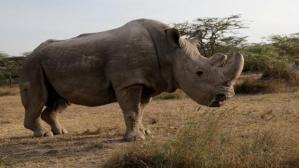
Two days ago, the last male northern white rhino (Ceratotherium simum cottoni) died. His passing leaves two surviving members of his subspecies: both females who are unable to bear calves.

Even though it might not be quite the end of the northern white rhino because of the possibility of implanting frozen embryos in their southern cousins (C. simum simum), in practical terms, it nevertheless represents the end of a long decline for the subspecies. It also raises the question: how many individuals does a species need to persist?

Fiction writers have enthusiastically embraced this question, most often in the post-apocalypse genre. It’s a notion with a long past; the Adam and Eve myth is of course based on a single breeding pair populating the entire world, as is the case described in the Ragnarok, the final battle of the gods in Norse mythology.

This idea dovetails neatly with the image of Noah’s animals marching “two by two” into the Ark. But the science of “minimum viable populations” tells us a different story.

No inbreeding, please

The global gold standard used to assess the extinction risk of any species is the International Union for the Conservation of Nature (IUCN) Red List of Threatened Species. Read the rest of this entry »


Predicting sustainable shark harvests when stock assessments are lacking

26 03 2018
srb 1

© Andrew Fox

I love it when a good collaboration bears fruit, and our latest paper is a good demonstration of that principle.

It all started a few years ago with an ARC Linkage Project grant we received to examine how the whaler shark fishing industry in Australia might manage its stocks better.

As I’m sure many are aware, sharks around the world aren’t doing terribly well (surprise, surprise — yet another taxon suffering at the hands of humankind). And while some populations (‘stocks’, in the dissociative parlance of the fishing industry) are doing better than others, and some countries have a better track record in managing these stocks than others, the overall outlook is grim.

One of the main reasons sharks tend to fair worse than bony fishes (teleosts) for the same fishing effort is their ‘slow’ life histories. It doesn’t take an advanced quantitative ecology degree to understand that growing slowly, breeding late, and producing few offspring is a good indication that a species can’t handle too much killing before populations start to dwindle. As is the case for most large shark species, I tend to think of them in a life-history sense as similar to large terrestrial mammals.

Now, you’d figure that a taxon with intrinsic susceptibility to fishing would have heaps of good data with which managers could monitor catches and quotas so that declines could be avoided. However, the reality is generally the inverse, with many populations having poor information regarding vital rates (e.g., survival, fertility), age structure, density feedback characteristics, and even simple estimates of abundance. Without such key information, management tends to be ad hoc and often not very effective. Read the rest of this entry »


The Effective Scientist

22 03 2018

final coverWhat is an effective scientist?

The more I have tried to answer this question, the more it has eluded me. Before I even venture an attempt, it is necessary to distinguish the more esoteric term ‘effective’ from the more pedestrian term ‘success’. Even ‘success’ can be defined and quantified in many different ways. Is the most successful scientist the one who publishes the most papers, gains the most citations, earns the most grant money, gives the most keynote addresses, lectures the most undergraduate students, supervises the most PhD students, appears on the most television shows, or the one whose results improves the most lives? The unfortunate and wholly unsatisfying answer to each of those components is ‘yes’, but neither is the answer restricted to the superlative of any one of those. What I mean here is that you need to do reasonably well (i.e., relative to your peers, at any rate) in most of these things if you want to be considered ‘successful’. The relative contribution of your performance in these components will vary from person to person, and from discipline to discipline, but most undeniably ‘successful’ scientists do well in many or most of these areas.

That’s the opening paragraph for my new book that has finally been release for sale today in the United Kingdom and Europe (the Australasian release is scheduled for 7 April, and 30 April for North America). Published by Cambridge University Press, The Effective ScientistA Handy Guide to a Successful Academic Career is the culmination of many years of work on all the things an academic scientist today needs to know, but was never taught formally.

Several people have asked me why I decided to write this book, so a little history of its genesis is in order. I suppose my over-arching drive was to create something that I sincerely wish had existed when I was a young scientist just starting out on the academic career path. I was focussed on learning my science, and didn’t necessarily have any formal instruction in all the other varied duties I’d eventually be expected to do well, from how to write papers efficiently, to how to review properly, how to manage my grant money, how to organise and store my data, how to run a lab smoothly, how to get the most out of a conference, how to deal with the media, to how to engage in social media effectively (even though the latter didn’t really exist yet at the time) — all of these so-called ‘extra-curricular’ activities associated with an academic career were things I would eventually just have to learn as I went along. I’m sure you’ll agree, there has to be a better way than just muddling through one’s career picking up haphazard experience. Read the rest of this entry »


Penguins cheated by ecosystem change

13 03 2018

Jorge Drexler sings “… I was committed not to see what I saw, but sometimes life is more complex than what it looks like …”*. This excerpt by the Oscar-winning Uruguayan singer seems to foretell the theme of this blog: how the ecological complexity of marine ecosystems can elicit false signals to their predators. Indeed, the fidelity of marine predators to certain feeding areas can turn demographically detrimental to themselves when the amount of available food shrinks. A study of jackass penguins illustrates the phenomenon in a context of overfishing and ocean warming.

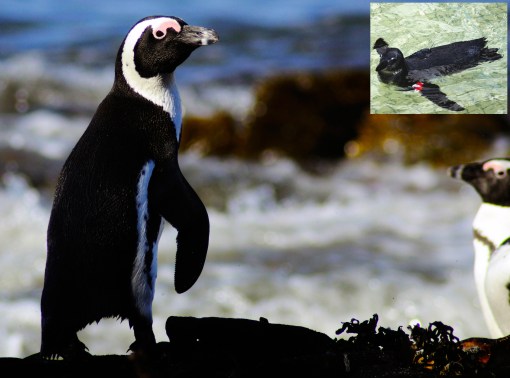
CB_JackassPenguinsEcologicalTrapPhoto

Adult of jackass penguin (Spheniscus demersus) from Robben Island (South Africa) — in the inset, one of the first juveniles released with a satellite transmitter on its back. The species is ‘Endangered’ under IUCN’s criteria (28), following a recent halving of the total population currently estimated at ~ 80,000 adults. Jackass penguins are the only penguins living in Africa, and owe their common name to their vocalisations (you can hear their braying sounds here); adults are ~ 50 cm tall and weigh ~ 3 kg. Photos courtesy of Richard Sherley.

Surface temperature, dissolved oxygen, acidity and primary productivity are, by and large, the top four environmental factors driving the functionality of marine ecosystems (1). Growing scientific evidence supports the idea that anthropogenic warming of the atmosphere and the oceans correlates with this quartet (2). For instance, marine primary productivity is enhanced by increased temperatures (3), but a warmer sea surface intensifies stratification, i.e., stacked layers of seawater with contrasting physical and chemical properties.

In coastal areas experiencing ‘upwelling’ (where winds displace surface water, allowing deep water laden with nutrients to reach the euphotic zone where plankton communities feast), stratification weakens upwelling currents and, in turn, limits the growth of plankton (4) that fuels the entire trophic web, including our fisheries. The study of these complex trophic cascades is particularly cumbersome from the perspective of large marine predators because of their capacity to move long distances, from hundreds to thousands of kilometres (5), with strong implications for their conservation (6).

With those caveats in mind, Richard Sherley and colleagues satellite-tracked the movement of 54 post-fledged, juvenile jackass penguins (Spheniscus demersus) for 2-3 years (7). All individuals had been hatched in eight colonies (accounting for 80% of the global population), and were equipped with platform terminal transmitters. Jackass penguins currently nest in 28 island and mainland locations between South Africa and Namibia. Juveniles swim up to 2000 km in search of food and, when approaching adulthood, return to their native colonies where they reproduce and reside for the remainder of their lives (watch individuals swimming here).

The natural history of this species is linked to the Southern Hemisphere’s trade winds (‘alisios’ for Spanish speakers), which blow from the southeast to the tropics. In the South Atlantic, trade winds sustain the Benguela Current, the waters of which surface from some 300 m of depth and fertilise the marine ecosystems stretching from the Western coasts of South Africa to Angola (8). Read the rest of this entry »


Cartoon guide to biodiversity loss XLVII

7 03 2018

The next set of six five biodiversity cartoons for 2018. See full stock of previous ‘Cartoon guide to biodiversity loss’ compendia here.


Read the rest of this entry »


Our global system-of-systems

28 02 2018

Complex-systems

I’ve just read an excellent paper that succinctly, eloquently, and wisely summarised the current predicament of our highly interconnected, global, complex adaptive system (i.e., our environment).

If you are new to the discussions around state shifts, hysteresis, tipping points, and system collapse, there might be a lot in the new paper by Philip Garnett of the University of York that you could find intimidating (and not just because of the complexity of the concepts he discusses). If you are more up-to-date on these discussions, I highly recommend reading this paper for distilling some of the more pertinent questions.

The essence of the paper is that our global environment (Earth) is one giant, complex system made up of interacting sub-systems. We can think of these as a giant, interconnected network of nodes and connections (often called ‘edges’) between them. If you do ecological network theory, then you know what I’m talking about.

What’s particularly fascinating to me is that Philip Garnett is not an environmental scientist; in fact, he’s a a lecturer in Operations Management and Business Analytics (although he does have a background in genetics and biology) who specialises in complex systems theory. In fact, much of his paper uses socio-economic examples of system complexity and collapse, yet the applications to environmentalism in general, and to ecological integrity in particular, are spot on.

Read the rest of this entry »